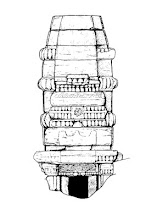
The truncated spire of Holy Trinity church in Minchinhampton may be a familiar landmark in these parts, but how much do locals know about the rest of the church? A new book by Stroud archaeologist Chiz Harward reveals the rich history of this often over-looked, but highly significant Cotswold church.

The south transept and truncated spire of Holy Trinity
The book is the result of several years of archaeological fieldwork and research triggered by a major reordering (refurbishment) of the church which involved taking up the pews and floors to install under-floor heating and fit a new stone floor to designs by Antony Feltham King of St Anne’s Gate Architects. The church commissioned Chiz, who specialises in church archaeology, to research the church and investigate alongside Nick Miles Building Contractors.
Excavations revealed traces of the medieval church with finds including inscribed designs of window tracery, fragments of memorials, coffin handles, graves and tombs, but Chiz says that it was when the excavated evidence was linked to old documents that the history of the church really came to life. ‘The documents, plans, paintings and records combined with the finds and the standing building to tell the complex story of the church and the people who built it, ran it, and worshipped there.’
After the chancel, nave and aisles were demolished in 1842
the builder -a man named Shepstone- wrote a description of the medieval church
he demolished; those details helped Chiz reconstruct aspects of the Norman
church, and the comprehensive rebuilding of the church in the early 14th
century when local patrons competed to leave their mark with some audacious
Decorated Gothic architecture. ‘We all know the spire and its coronet, but it
is the south transept, built to commemorate John and Lucy Ansley in 1330, that
is the jewel of the church and one of the finest pieces of Decorated
architecture in the region. The rose window, the stone roof and scissor vault,
and the heavily buttressed walls was a piece of absolutely first-class
groundbreaking architecture’.
The nave under excavation, scale 1m
.jpg)
The Decorated wheel window of the early 14th century south transept draws its inspiration from Old St Paul's cathedral
That 14th century church was Catholic, its new chapels
dedicated to saints and the souls of wealthy benefactors, its walls echoing to
the mass and richly decorated with statues and altar hangings, but there is
also evidence for the Reformation two hundred years later with the traumatic
ebb and flow of Protestant and Catholic faith seen through the purchases of
simple sundries such as candles and incense, wine and books.

Late 16th century 'textura quadrata' text painted on wall plaster
‘We found fragments of wall plaster painted with text, from
the punctuation we could see that it was written in English, not Latin, and
stylistically dated to the later 16th century when the church was
Protestant; when we looked in the Churchwardens’ Accounts there was a reference
to an Adam Painter being paid 4 shillings for painting the Ten Commandments on
the walls in 1594. Were those fragments painted by Adam?’
By 1842 the church was in poor repair and philanthropic lord of the manor David Ricardo had the church largely rebuilt by architect Thomas Foster, who designed Whiteshill and Brimscombe churches, and remodelled Rodborough and Chalford churches. Holy Trinity was rebuilt just as the Gothic Revival was getting going, but was really a late Georgian Gothick design -a letter from eminent Gothic Revival architect William Burges was disparaging of Foster’s work and lamented the loss of so much medieval fabric; Burges rebuilt the chancel with a double-plane east window echoing the tracery of the south transept's wheel or rose window, adding some much-needed 'bling' to Foster’s austere Perpendicular.
After the latest building campaign the church is now warm,
bright and used. The new book is to be launched with a celebration
at the church on 17th May, with a talk on the church by Chiz Harward and
an update on the latest project -the restoration of the stained glass. Books
will be available to purchase on the night.
Burges' stunning double plane tracery in the east window
‘If the sign of a successful church is a busy diary then trying to find a slot for the book launch shows that the recent refurb has made Holy Trinity a truly successful church, used every single day by different groups, and open every single day to worshippers and visitors. It’s been absolutely fascinating to work here and get to know the church so well’.
And the spire? Well it seems that after many years of problems, with numerous bills to surveyors, builders and leadworkers, the spire was finally reduced in 1563, giving the church its distinctive profile.
‘Your Church Newly Built…’ a History of the Church of the Holy Trinity, Minchinhampton, Gloucestershire, by Chiz Harward is published in April by Hobnob Press, copies are available from Holy Trinity church, bookshops, Hobnob Press and online retailers.



 Posts
Posts