Welcome to the Urban Archaeology blog. Chiz Harward provides a range of archaeological services including desk-based assessments, evaluations, excavations, watching briefs and post-excavation services, training and development work, and archaeological illustration.This weblog will carry news of projects as and when they happen as well as wider thoughts on archaeological issues, especially recording, stratigraphy and training.
For a few years Urban Archaeology has been producing factsheets on various subjects from artefacts to excavation techniques. These are now being updated and expanded and over the next few months we will be making the new sheets available online for free dowload.
Our site at Horse and Groom is now over, but we still have
plenty of work to do. One job is to create elevations of all the walls of the
medieval buildings. These will be used to illustrate the final report, but most
importantly they form a key part of our record of the site. We are using a
technique called photo-rectification as it is a quick and effective method that
takes less time on site, but still allows for accurate results.
So far the winter here in Gloucestershire has been mostly mild and wet and very windy rather than cold and snowy, but I thought it worthwhile to repost this piece I wrote for the Diggers' Forum a few years ago. Winter is always a challenging time for those working on site, and with the current gales and wet weather this year is no different and its not likely to get a lot better for a fair while yet. We've put together a few tips for both diggers and supervisors to help you survive the winter –after all, it may keep coming til April!
Cold weather working: a survival guide
Pretty skies, but can you see what you are digging?
The excavations at Horse and Groom Inn have been in the news recently -we were featured in The Sun as well as in local papers and news websites. There'll also be a longer piece on the site in the next issue of Current Archaeology -out on 2nd January.
One of Urban Archaeology’s wider aims is to develop
training materials for use on archaeological sites. For several years we
produced an occasional and ad hoc series of hand-outs and reference sheets for use in identifying finds and aiding in the
recording and interpretation of archaeological features and site formation processes.
A couple of years ago Urban Archaeology applied for grant
funding to develop a series of factsheets based on common classes of artefacts;
unfortunately we weren’t successful however we did prepare a pilot version of a
Roman Ceramic Building Material (CBM) Factsheet containing information on types
of CBM found in London. The concept was for a free downloadable A2 poster that could
be displayed in site huts and tea rooms, with smaller A4 versions available as handouts,
or potentially viewed on smart-phones. There's a downloadable version of the pilot factsheet below -the fonts don't view very well on the Scribd website, so its best to download it and it will open as a pdf.
We’d be very interested in any feedback on the format and the
level of content, especially if anyone is interested in sponsoring or helping
develop what we feel would be a great resource for archaeologists!
Since August Urban Archaeology has been working for LP Archaeology
excavating the remains of a medieval farm in a pasture field next to The Horse and Groom Inn, Bourton on the Hill in the Cotswolds. The pub is building a new
car park which needs to be terraced into the hillside and which would remove all
the archaeological remains, so we are excavating these before the ground
reduction.
Aerial view of the site looking north showing some of the medieval farm buildings
Trial trenches in 2011 showed that there was a varied range
of remains on the site: a large Iron Age ditch, a Roman pit containing building
rubble and grain-processing waste, medieval pits and postholes, and the remains
of at least one stone-built medieval building. However when we stripped the site
we hadn’t really expected to find an almost complete ground plan of a medieval
farm, with nine rooms -each measuring approximately 5m by 5m- and with some
walls surviving to 1.2m in height.
We can tell a lot about the medieval buildings on our site at
Horse and Groom Inn from the physical remains that survive, but there are also
other clues to the appearance of the buildings, some of which can be inferred
from what is not there, rather than
what is.
We've been using photogrammetry to record parts of our medieval farm site at Bourton on the Hill. This computer-generated animation of the small room featured in our last blog post was produced using photogrammeric techniques.
Photogrammetry is an established archaeological recording technique and uses photographs to create reconstructions of buildings, structures and sites. In traditional photogrammetry fixed 'targets' are used as reference points to 'stitch' the photographs together and 'rectify' them to the correct scale and viewpoint. Increases in computing power have led to computer-based photogrammetric programs that can combine many digital photographs to create 3-D models of the subject without the need for targets. The models can be rectified (scaled and located spatially) so that we can then produce scale 2-D drawings from the 3-D model, these drawings are then used in the post-excavation work and as illustrations in the final published report.
The weather has definitely turned since our Open Day at the
medieval building complex at Horse and Groom Inn Bourton-on-the-Hill, but work has carried on. We’ve
been concentrating on removing the last of the rubble infill of the rooms and
we’re nearly there.
Today Urban Archaeology and LP Archaeology held an open day
at our excavations at Bourton on the Hill in the Cotswolds. Despite the weather
early on being rather dreich we had a
steady flow of visitors who viewed the medieval buildings and a selection of
our finds, and could ask questions of the site team. And by the afternoon it
was a beautiful autumnal day.
We are still working on the LP Archaeology site at Bourton on
the Hill, next to the Horse and Groom
Inn. The site contains extensive remains of a series of medieval buildings, well preserved beneath layers of rubble. Gradually we are removing those thick layers of rubble collapse from within and around the medieval
buildings. Scorch marks on some walls suggest a possibly catastrophic cause of abandonment, but this may be just from localised burning -it is early days yet and we need to unpick more of the site sequence. It does however seem that the rubble from the abandoned walls may have been sorted through and the best of the
stone taken for reuse elsewhere in the village.
For the last few weeks Urban Archaeology has been
running a site for L - P : Archaeology ‘somewhere in
Gloucestershire’. The site is quintessentially rural –commanding views across
the Cotswolds, sheep grazing the spoil heap, church bells counting the hours,
but archaeologically it has a decidedly urban feel.
Evaluation in 2011 showed that the
site has Late Iron Age and Roman occupation, however sealing all this is a medieval building sequence that wouldn’t be
out of place in an urban environment. For the past fortnight we have been
removing the layers of soil and limestone rubble that had developed after the
buildings went out of use, we have now defined most of the walls and are now
removing rubble and silt infilling above the floor levels. So far we have over
ten rooms of up to 6m by 6m which are terraced into the hillside and arranged
on two sides of a courtyard. The walls are of local Cotswold Stone and are
nearly a metre thick and they survive up to 1.2m high in places. Burning on
some walls suggest that some of the buildings may have burnt down although
we’ll need to get down to the floors to find out for certain.
When I signed up to Day of Archaeology I thought I would be out
on site, I didn’t know where–originally it looked like a big site in London,
but that has been delayed, and then it seemed I’d be up the road on a site I
evaluated a couple of years ago. As the recent heat wave began I became a bit apprehensive
at the idea of digging 3m wide rubble-filled ditches in the baking heat, but
that site slipped
too…
So I am in my office finishing off the report for some
recent fieldwork I did in west Nepal for the Central Himalaya Project. The project
intended (amongst other aims) to record a sample of medieval stone monuments
belonging to the Malla dynasty, evaluate the suitability of recording
techniques including photogrammetry,
and try and develop a database for future assessment and analysis. In total we recorded
58 sites, with 32 temples, assorted other sites and monuments, and over 80
architectural fragments. The fieldwork was hard work –up by 6am, lug all the gear
to site, work through the day with a short break and back at 7pm for data entry
and downloading. But the team was good, the weather was hot, the beer was ice
cold and the scenery and locals were fantastic. It didn’t exactly feel like a ‘jolly’
as all my mates called it, but it was quite nice to be sipping single malt
looking at the stars and glad there wasn’t a CSCS card for thousands of miles.
The downside of any expedition is coming home, and with
archaeology that doesn’t just mean returning to work, but writing up your
results. Fieldwork somehow always seems more ‘fun’ than the grind of
office-based Post-Ex, and there has been plenty of checking and cross-referencing
of records, data-entry, and form-filling to do. The monument gazetteer seemed
endless, the temple terminology impenetrable, and there were seemingly hundreds
of drawings to check, ‘ink up’ in Corel-Draw and work out exactly what each
stone fragment might represent.
In amongst the grind there are moments when it all comes
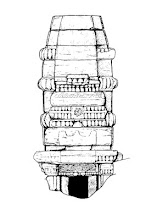
together, managing to reconstruct a ‘lost’ temple from fragments of stone, the
satisfaction of finding that your thoughts on temple architecture were echoed
by published works, the realisation that common motifs and styles were being
used across hundreds of miles and on a wide variety of monuments of both Hindu
and Buddhist origin.
The
draft report is now complete, its 160 pages, 42,000 words, and nearly 100 illustrations.
At times when writing it I wished I hadn’t recorded so many monuments, but now,
having completed the work I just want to go back and record more!
I was meant to be working on site today; at
less than an hour’s drive up the road it would have made a pleasant change from
working several hours’ drive away, but the site start date has slipped. It’s a
fairly common occurrence and can happen for any number of reasons, sometimes
down to delays in planning permission or due to other construction work, the
client’s cash flow, or sometimes just the weather. Sometimes sites go into
apparent hibernation and only resurface months or even years down the line,
when suddenly you get a call or an email saying that 'the footings are being
pulled next week, where are you'!
On this occasion it is due to planning
control and not yet having the Written Scheme of Investigation signed off –this
is the document that says what we will do on site (and afterwards), and how we
will dig and record it, and it has to be approved by the local Planning
Archaeologist within the relevant local authority. Ours is still in limbo, so
the site can’t start.
Managing the flow of work is never easy, and
is part of the reason why site staff contracts are often short, and not
extended until the last minute –no-one knows if the work will be there on
Monday. When you are a sole trader it gets harder –you either need to be able
to clone yourself to deal with a glut of work, or find something to fill the
hours when a job slides. It is almost always outside your control, and
sometimes there seems to be little that can be done to mitigate the problem. My freelance work is luckily not restricted
to site work –I’m also an illustrator, create training materials, do
grant-funded research and I carry out post-excavation and publication work on
various archaeological projects. All this work often has slightly less
demanding deadlines than the fieldwork -it has to be done, but the deadline is
usually 'tomorrow', rather than 'yesterday'. So having a mix of different types
of projects gives me the flexibility to be able to deal with last minute delays
to sites. Picking up and putting down projects every few days isn’t the most
efficient way of working, but sometimes you have to do it: its a juggling
act.
Day to day the juggling of current jobs is
usually ok, and you do get the occasional day off to counterbalance the runs of
18 hour days required to meet deadlines. The bigger impact of slippage is in
tendering for future work as it may take a month or longer for sites or PX
programmes to go live, and all the time all your jobs are slipping, being
brought forward, and morphing from one day watching briefs into three week
excavations. The Year Planner starts to look like 4-D Tetris, and its often
only at the last moment that it all comes together.
So today, instead of digging a late
prehistoric/Roman and medieval site next to a pub in the Cotswolds, I am
finalising the report on a project I did in Nepal earlier in the year…
I've just finished processing some of the record shots from the recent fieldwork in Nepal. I'm using Autodesk 123D Catch to stitch digital photographs and create 3-D photogrammetric models of a sample of the monuments so we can see if this is a viable way of recording monuments quickly and accurately. An added advantage is you can easily create animated fly-throughs of the models that give a 3-D impression of the actual monument which is great and has lots of potential uses within a project that aims to help enable heritage tourism.
This 3-D model was created using standard archaeological record shots, for a full 3-D model we'd have needed to take many more photos to cover all the angles, still it gives a good idea of what is possible given a bit of time and a digital camera.
The featured monument is a nauli or waterpoint at Bhurti in Dailekh, West Nepal. It is 20 yards or so from the major Khasa Malla temple site of Bhurti, which has 22 intact temples, plus the remains of potentially many more. I'll add some more fly-throughs as and when I get them processed.
We are waiting for the last of the team to arrive and are still
in the town of Surkhet, down at about 700m altitude in the middle of a
roughly circular valley surrounded by hills. The town has got increasingly busy over the 13
years since my last visit and has a large bustling bazaar and on a sunny day
like this is a great place to soak up the atmosphere of being back in Nepal.
This morning I went on a short sightseeing
trip to the remains of the Buddhist Kankrevihar temple which is about 15
minutes drive outside Surkhet on a wooded hill in the centre of the valley.
View of temple platform, surrounded by carved stones
The temple had either collapsed or been destroyed at some
point in the past and the site was
In 1998 I spent two months walking across Nepal from the southern Terai to
the mountains and valleys north of Jumla. Logistically the expedition was
totally self-supporting (bar the odd bit of spinach) and worked its slow way
across a changing landscape from the flat plains of the Terai through arid foothills, across alpine
meadows to wide gravel valleys with braided rivers, lush terrace systems and dense
forested slopes. The aim was to carry out a reconnaissance of surviving
monuments along a 'royal road' between the Summer and Winter capitals of a
medieval kingdom that helped shape modern Nepal: the Khasa Malla.
I was reading this post about CVs on Doug's Archaeology site, its one of two good posts Doug has written on CVs, the other one is here. I wrote an article back in 2010 for the Diggers' Forum on CVs and thought I would repost it here, its a rough guide to archaeological CVs, plus how to get hired without the magical '6 months of commercial experience'. It was originally published in the Forum Dispatch Issue 5.
Professional archaeology is still a small world where most people will know someone who knows you, but the days of getting jobs down the pub and by word of mouth are (mostly) gone. This article gives some advice for the those looking for site work. It is primarily intended for those at the start of their career but the advice is just the same for old lags struggling to cope with the baffling world of email applications and HR forms.
Text of presentation to CAAUK 2013, video of the presentation is available on Doug's Archaeology blog HERE.
This paper is from the
perspective of an archaeologist who works principally on urban sequences, I am
neither a technophile nor a complete Luddite, but Guy [Hunt, Partner at LP: Archaeology] felt it would be good to
get a digger’s input into the debate.
I wrote the initial abstract
after a conversation with Guy, and as with all things it has evolved into
something more or less completely different. What I’d like to talk about is
some of the issues around technology on site –from a fieldworker’s perspective-
using London as an example, and with a case study of where we have been
successfully using new technology.
First off I think its worth
giving a brief run down of London’s archaeological landscape –in terms of how
we excavate and analyse our sites:
The Computer Methods and Quantitative Methods in
Archaeology -UK Conference (CAAUK) is being held in London on the 22nd-23rd February, hosted by L-P: Archaeology. The programme and abstracts are now out, and it looks like a really good mix
of papers. I will be giving a paper on urban excavation and analysis techniques
that will look at how we can use computer applications to create elegant
systems and enable better excavation:
For the last 40
years the excavation of urban sites has increasingly been characterised by the
use of single context recording; for the last 25 years the post-excavation
analysis of these sites has been increasingly characterised by a system of
aggregation into larger stratigraphic groups (context<subgroup<group<landuse).
These systems have been increasingly integrated with digital recording systems,
databases and GIS systems. It is a testament to the logic and rigour of the
original processes that they generally work very well within the digital
systems that have been developed.
This paper will
outline some current approaches to excavation and post-excavation used within
London. It will highlight the role of databases and GIS, and will explore how
we can integrate the excavation processes and recording systems to achieve
better results on site and in post-excavation. The paper will also outline how
we may increasingly utilise modern technology on site to facilitate these
systems and enable the archaeologists on site make better use of their time,
and make more informed decisions about the excavation process. http://www.lparchaeology.com/caauk/integrating-excavation-and-analysis-on-urban-excavations/
Urban Archaeology's Chiz Harward is carrying out a survey of medieval cross-slabs in Gloucestershire, for more information please see: http://gloscross-slabs.blogspot.co.uk/
About Urban Archaeology: Chiz Harward
Chiz has worked within the archaeological profession for thirty years across the UK, working within the historic core of London for over fifteen years. Chiz was a Senior Archaeologist and Project Officer at the Museum of London Archaeology Service from 1998-2008, where he supervised, assessed and analysed some of London's largest and most complex excavations, as well as numerous smaller sites and projects.
Chiz specialises in the excavation and analysis of complex archaeological sites, especially urban, monastic and church archaeology.
Chiz is also an experienced archaeological illustrator and has been developing training materials for several years.
Between 2008 and 2010 Chiz worked as a freelance archaeologist trading as Urban Archaeology. This is the Urban Archaeology blog. After a two year stint as a Senior Project Officer at Cotswold Archaeology, Chiz is back working as a freelance archaeologist.
Urban Archaeology is on Facebook. 'Like' the page to get the latest news and thoughts from Urban Archaeology
Chartered Institute for Archaeologists
Chiz Harward is a Member of the Chartered Institute for Archaeologists (MCIfA), the highest level of individual accreditation. Chiz served for 4 years on the IfA Council, and was previously a member of the Professional Development and Practice Committee, Registration Committee (Organisations), the IfA Working Party on Self-employment, and the IfA Remuneration Working Party. Chiz was also chair of the Diggers' Forum and edited their newsletter: the Forum Dispatch.
Chiz strongly believes in producing work of the highest professional and ethical standards, complying with the professional standards and Code of Conduct of the professional body for archaeologists: The Chartered Institute for Archaeologists.



 Posts
Posts